Organises by meaning. Not by where you put it.
Most tools help you write more. Taggard helps you lose less of what you've already written, read, or thought.
Upload a document and Taggard tells you: this connects to five earlier notes, an abandoned idea, two documents, and a project you were working on last year. That is when it starts working like a second memory rather than a filing cabinet.
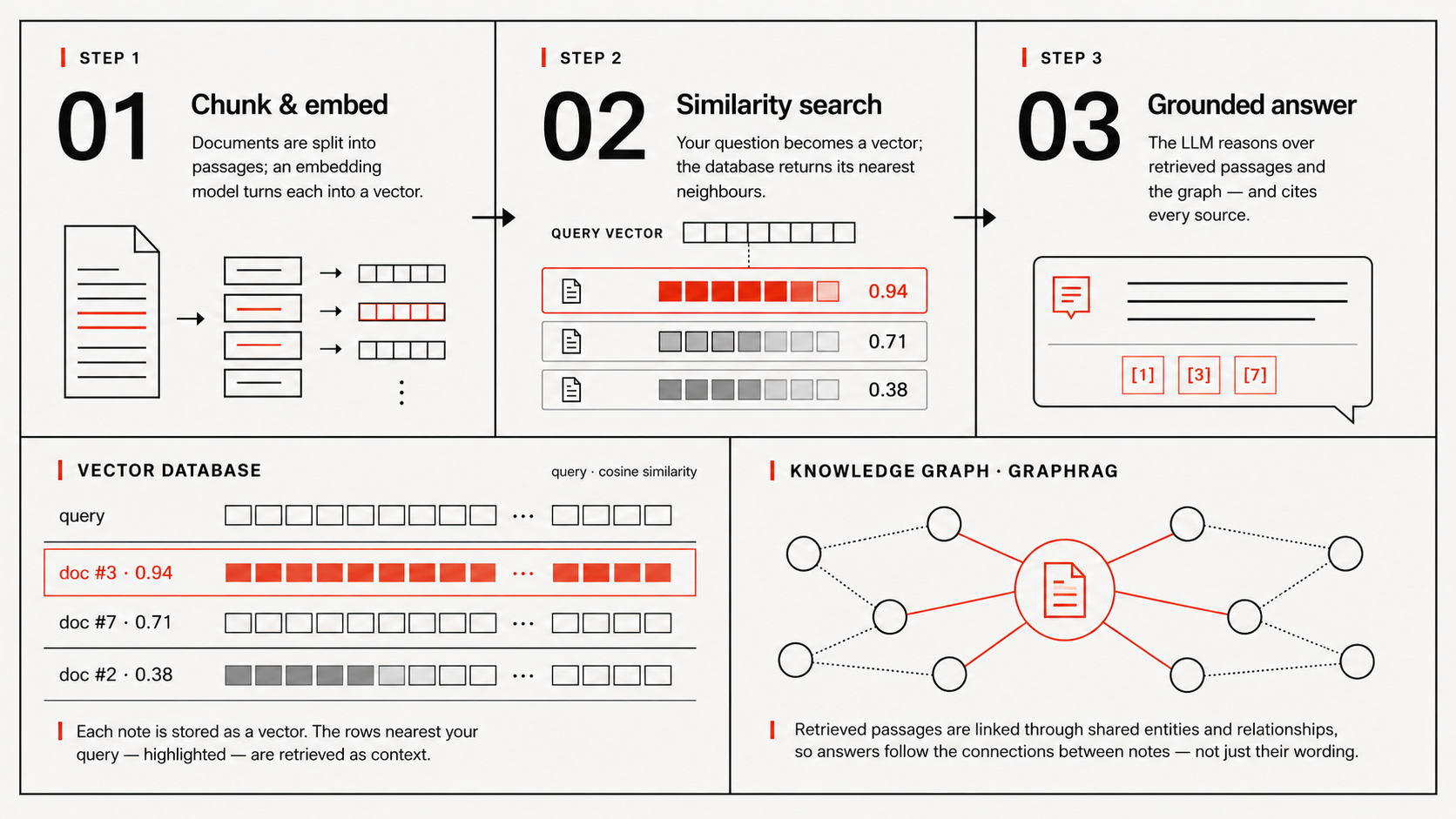
How a question becomes an answer.
Every document you capture is split into passages and converted into vectors - coordinates in a high-dimensional meaning space. When you ask a question, Taggard embeds it the same way, finds the nearest passages in the vector database, cross-references the knowledge graph, and hands the LLM only what matters - with sources attached.
Where Taggard works differently.
Every document is read once by the AI, then decomposed into nine machine-readable signals - each stored so it can be searched, linked, and reasoned over later. These are not labels; they power discovery without cluttering your view.
One note in, a web of intelligence out.
Read once. Enriched into the nine structures alongside - plus its embedding vector.
AI extraction →People, places, organisations, dates
How those entities connect
Recurring ideas across many notes
Notes that point at each other
Conclusions that disagree
How a thought changed over time
Meaning grouped, not keywords
Tone, and choices made
How sure, how strongly linked
Feedback loop - every time you correct a tag, that edit tunes what Taggard extracts next.
These signals let Taggard find connections that ordinary search - and ordinary AI - would miss.
Memory, not storage.
“You wrote something related to this three months ago.”
“You have three notes that appear to be forming a larger idea.”
“This document may be relevant to your current project.”